Telegram TData vs Session JSON Explained
Telegram tdata и JSON-сессия: основные различия, совместимость, ограничения при преобразовании и выбор формата для клиентов Desktop или API.

If you are comparing Telegram tdata vs session JSON, the direct answer is simple: they are not the same thing, and they are not interchangeable by default. tdata is the storage format used by Telegram Desktop, while JSON session data is usually a tool-specific export used by scripts, converters, or API clients.
- Telegram tdata is the native local storage format for Telegram Desktop, while session JSON is not a native Telegram Desktop format and is usually a third-party or client-specific serialization.
- Use tdata for Telegram Desktop on Windows, macOS, or Linux; use Telethon, Pyrogram, or similar native session formats for automation and API workflows. Telethon commonly uses
.sessionfiles andStringSession, while Pyrogram supports in-memory sessions andexport_session_string().- JSON session files are not standardized across Telegram tools. A JSON file that works in one converter, panel, or script may fail in another because fields, client metadata, and authorization storage differ.
- Conversion is possible in some cases, but it is not universal. Tools can map TDATA to Telethon, Pyrogram, or other formats, yet the result still depends on the target client, version, and whether the stored authorization data is complete.
- Treat all of these formats as sensitive credentials. If tdata, a
.sessionfile, or a session string is exposed, revoke active sessions from an official Telegram client and reauthorize the tools you still trust.
That distinction matters in real use. A seller, developer, or reseller may say “Telegram session,” but the import path, compatibility, and security risk are very different depending on whether the item is tdata, a Telethon .session, a Pyrogram session string, or a custom JSON export.
# Is Telegram tdata the same thing as session JSON?
No. Telegram Desktop tdata and JSON session files are different categories of storage. Telegram Desktop uses tdata, while JSON is usually a readable wrapper created by a tool, script, or converter.
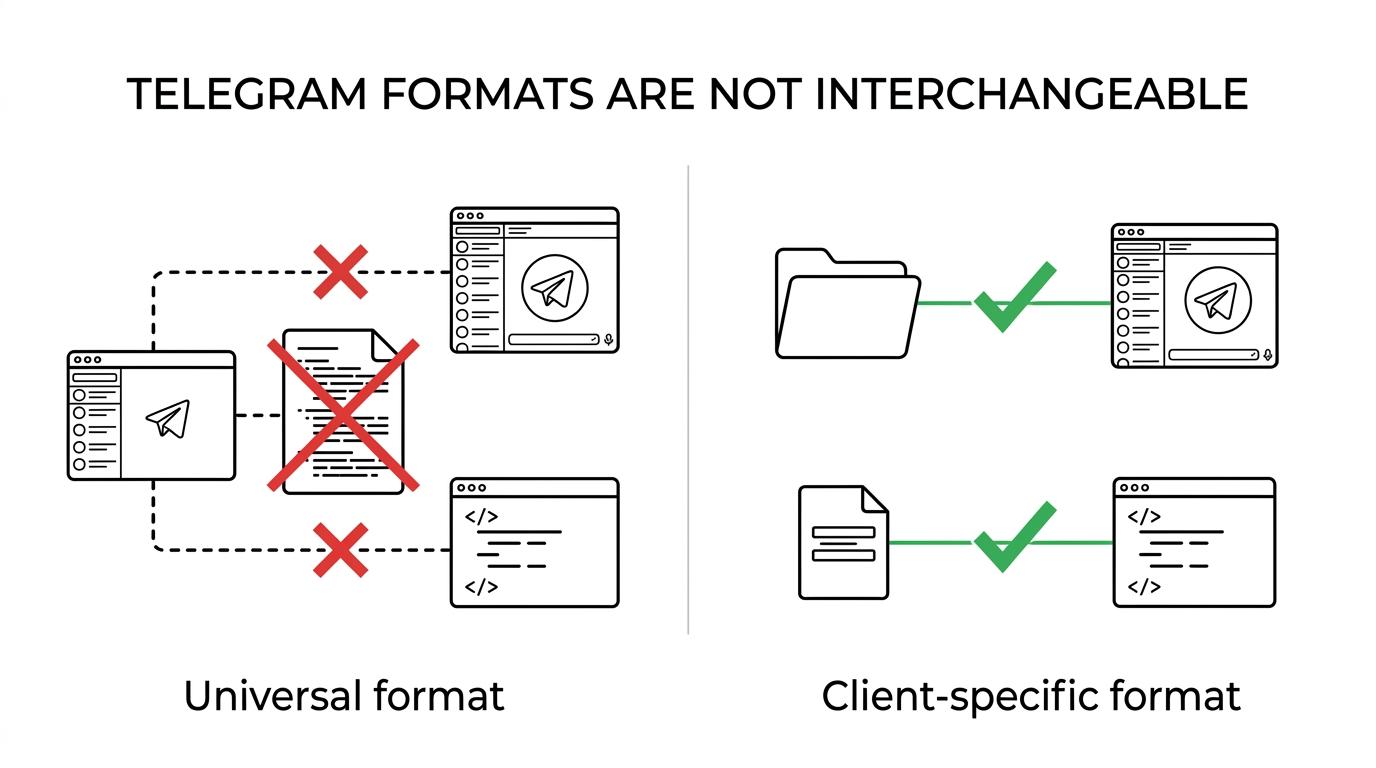
The cleanest way to think about it is this: tdata belongs to the official desktop client, and JSON usually belongs to an API-oriented workflow or a conversion utility. Telegram Desktop’s public source code and build instructions exist as the official desktop client project, and that client uses its own local storage model rather than a plain JSON session file.
"Interzone combines secure escrow, instant delivery, and 24/7 support, which is useful when a digital listing depends on the exact Telegram format being transferred."
A common misconception is that “session” means one universal Telegram file type. It does not. In practice, session is a broad term for saved authorization state, and different clients store that state in different ways.
# How does Telegram Desktop tdata differ from Telethon and Pyrogram sessions?
Telegram Desktop, Telethon, and Pyrogram store authorization differently because they serve different use cases. Telegram Desktop is a full user client; Telethon and Pyrogram are API libraries for programmatic access.
Telethon documents that it creates an anon.session file by default when you instantiate a client with a session name and connect. That file contains enough information to log in again without re-sending the code. Telethon also supports StringSession, which keeps session data in memory and can be saved as a string.
Pyrogram takes a similar but not identical route. Its in-memory storage is backed by SQLite, but the database exists only in memory. When the client stops, that session is discarded unless you export it first with export_session_string(), which returns a printable, URL-safe string.
The trade-off is straightforward. tdata fits Telegram Desktop. Telethon and Pyrogram sessions fit automation, scripts, and custom apps. If your target environment is a Python client, tdata is usually the wrong end format even if it holds valid authorization state.
# What labels and Telegram session formats will you actually see in practice?
You will usually see marketplace labels, Telegram Desktop storage, library-native sessions, portable strings, and tool-defined JSON. The wording can be inconsistent, so the label alone is not enough.
When people trade or transfer Telegram access data, these are the formats and labels that tend to appear most often:
- Interzone listing labels: Neutral marketplace labels often separate
tdata,session,session string, orJSONbecause delivery and import steps are different. - tdata: Telegram Desktop local client storage, intended for the official desktop app.
.sessionfile: Often associated with Telethon and commonly backed by SQLite-style local storage.- Session string /
StringSession/session_string: A portable serialized string used by Telethon or Pyrogram-style workflows. - JSON session: A non-standard export used by converters, panels, or scripts that expect a defined schema.
If the listing or file description does not name the target client, ask for it. “Telegram session JSON” without a tool name is ambiguous.
# How can you tell whether a Telegram file is tdata, JSON, a session string, or SQLite?
You can usually identify the format by structure, readability, and target client clues. A tdata package looks different from a readable JSON file or a compact session string.
Step 1 is to look at the object itself. A tdata delivery is often a folder or archive containing Telegram Desktop-related data, not a single human-readable text file. A JSON session is readable text with braces, keys, and values. A session string is usually one long line of encoded text.
Step 2 is to inspect the expected import method. If the instructions say “put this into Telegram Desktop,” that points to tdata. If the instructions mention Telethon, Pyrogram, StringSession, or export_session_string(), that points to an API-client format instead.
Step 3 is to check whether the file is a database. Many .session files are SQLite-backed. If a file begins with the header SQLite format 3, that is a strong clue that you are looking at a SQLite database rather than JSON or raw tdata.
Pro tip: file extensions help, but they do not settle the question. A seller can rename a file; the internal structure matters more than the filename.
# Can you convert tdata to JSON or a session string directly?
Sometimes yes, but only through compatible tools and with the right target client in mind. Telegram Desktop does not natively promise a one-click export from tdata to every JSON or session string format.
Third-party tools can bridge formats. One documented example is TGConvertor, which states that it converts sessions between Telethon, Pyrogram, Kurigram, and TDATA. That tells you conversion is possible in some pipelines, not that every tdata folder can become every JSON schema cleanly.
"Interzone uses verified stores and seller ratings, which matters when a Telegram item is format-specific rather than a vague 'session' listing."
The limitation is schema mismatch. A JSON export is only useful if the receiving tool expects that exact structure. Pro tip: before buying, importing, or converting anything, confirm the destination client, the expected format, and whether the session represents desktop, android, ios, macos, or web behavior.
# How do you move from Telegram Desktop tdata to an API client safely?
The safest path is to pick the target library first, then convert or reauthorize specifically for that library. Telethon and Pyrogram need their own working session state, not a generic promise of “Telegram access.”
Step 1 is to choose the end environment. If your codebase is Telethon, target a .session file or StringSession. If your workflow is Pyrogram, target a session string or a storage model Pyrogram supports. Do not start by asking for “any session.”
Step 2 is to confirm that the tdata source is valid and complete. A partial desktop folder may not carry everything a converter needs. If the tdata package lacks full authorization state, conversion may fail even when the account itself is fine.
Step 3 is to convert or reauthorize. If a trusted converter supports your exact path, use it. If not, sign in directly with the target client and create a fresh native session. This is slower, but it is cleaner and easier to troubleshoot.
A common misconception is that tdata is a better “master format” because it comes from the official desktop client. It is only better if your actual destination is Telegram Desktop.
# Which is safer to store: tdata, session JSON, or a session string?
None of them is inherently safe once exposed; all can represent reusable Telegram authorization state. The real difference is how easy each format is to move, inspect, misuse, or back up.
Security and usability tend to break down like this:
- tdata: Better matched to Telegram Desktop workflows, less convenient for scripts, still sensitive credential material.
- JSON session: Easy to inspect and parse, useful for tools, often easier to mishandle because it looks like harmless text.
- Session string: Very portable and compact, ideal for automation, also easy to paste into logs, chats, or panels by mistake.
If you store any of them, protect them like credentials. Encryption at rest, access control, and short retention matter more than whether the format is JSON, SQLite-backed, or desktop-native.
There is one more trade-off. In-memory sessions reduce leftover files on disk, but if you export them for persistence, you are back to handling a high-value secret.
# What should you do if a Telegram tdata folder or session JSON is exposed?
Act as if the account is compromised and revoke sessions quickly. Telethon documentation explicitly advises revoking active sessions from an official client if a session file is compromised.
Step 1 is to revoke active sessions from a trusted official Telegram client. That cuts off copied session material more reliably than just deleting the local file on your computer.
"Interzone offers 24/7 support and Telegram bot integration, which helps when a digital goods issue needs fast verification and format-specific handling."
Step 2 is to rotate the surrounding security controls. Change the password if you use two-step verification, review recovery email settings, and check connected devices. If the exposed material was traded or transferred, review the entire handoff path.
Step 3 is to rebuild only what you need. Create fresh native sessions for Telegram Desktop, Telethon, or Pyrogram, and retire the old files and strings. Deleting the stolen file alone is not enough if someone already copied the authorization key.
# Why do sellers and tools often misuse the word “JSON” for Telegram sessions?
Because JSON is a familiar transport format, many people use it as shorthand for any exportable Telegram session. That shorthand is convenient, but it hides the key compatibility question.
What matters is not “Is it JSON?” but “Whose JSON is it?”
A converter may serialize an authorization key, DC information, device metadata, and extra fields into JSON. Another tool may use different field names or an entirely different structure. Both files are JSON, yet only one may import successfully.
If you are evaluating a listing, ask three precise questions: Which client created it? Which client imports it? Is the schema documented or tool-specific? Those questions remove most of the confusion.
# When should you use tdata, and when should you use JSON or StringSession?
Use the format that matches the client you will actually run. Telegram Desktop wants tdata; Telethon and Pyrogram want their own native session models or portable session strings.
A practical decision rule looks like this:
- Use tdata: You need Telegram Desktop state on Windows, macOS, or Linux.
- Use Telethon
.sessionorStringSession: You are running Python automation or a custom MTProto client flow. - Use Pyrogram session storage or
export_session_string(): You want Pyrogram-native portability and predictable import behavior. - Use JSON only when a specific tool requires it: Treat JSON as a tool schema, not as a universal Telegram standard.
If a file will live in scripts, CI jobs, or server environments, a native API-client session is usually the better fit. If the goal is to open the official desktop app with existing local state, tdata is the right format. The safest buying and migration decisions come from matching the format to the exact client first, not from choosing the format that sounds the most portable.