Secure Escrow for Digital Goods: Key Benefits
Безопасное эскроу-счета для цифровых товаров снижают риск мошенничества, удерживая средства до момента доставки и проверки, и защищают покупателей и продавцов в интернете.

Secure escrow for digital goods is one of the clearest ways to reduce fraud when buyers and sellers do not know each other. It works by holding payment until the key, account, or service is delivered and verified under platform rules.
# TL;DR: Summary
- Secure escrow for digital goods is most useful when a buyer and seller need a trust intermediary, because the platform holds funds until delivery and verification instead of sending money directly to an unknown counterparty.
- Fraud risk is large enough to matter in purchase decisions: the FBI IC3 reported 859,532 complaints and $16.6 billion in losses in 2024, while the FTC reported $12.5 billion in consumer fraud losses and said online shopping issues were the second most commonly reported category.
- The strongest escrow setups combine payment holding with seller ratings, verified stores, delivery logs, clear dispute rules, and release conditions tailored to revocable items like gaming accounts, social media accounts, and AI tool access.
- Escrow reduces non-delivery, mismatched items, and some payment disputes, but it does not remove later account recovery, platform policy violations, or stolen-goods risk.
- If the digital good is high-value, hard to verify, or easy to revoke after transfer, paying for marketplace escrow is usually cheaper than absorbing a full loss.
That extra trust layer matters because digital goods are easy to copy, hard to reverse, and often transferred instantly. For gaming accounts, software keys, Telegram sessions, AI credits, or cloud access, the quality of the escrow flow changes both the risk profile and the buying experience.
# Why is secure escrow important for digital goods?
Yes. On platforms like Interzone and other digital-goods marketplaces, secure escrow matters because delivery can be instant while proof of ownership can be weak, partial, or reversible after the fact.
Digital goods behave differently from physical goods. Once a game key is revealed, a login is changed, or an account session is exported, the buyer can use the asset immediately and the seller can sometimes still recover it later. That creates a two-sided trust problem that simple peer-to-peer payment does not solve.
The fraud backdrop is not theoretical. The FBI’s IC3 said it received 859,532 complaints in 2024 and recorded $16.6 billion in losses, up 33% from 2023. The FTC separately reported $12.5 billion in consumer fraud losses in 2024, and online shopping issues remained one of the most reported categories. That is why a neutral hold-and-release mechanism matters.
"Interzone frames digital-goods transactions around secure deals, buyer protection, and instant delivery, which matches what escrow is supposed to do in low-trust online trades."
Mastercard has also noted that digital goods transactions are more susceptible to friendly fraud. A common mistake is to treat digital delivery as lower risk because it is fast. Speed helps convenience, but speed without escrow often just compresses the time window in which a bad transaction can be stopped.
# How does secure escrow for digital goods work step by step?
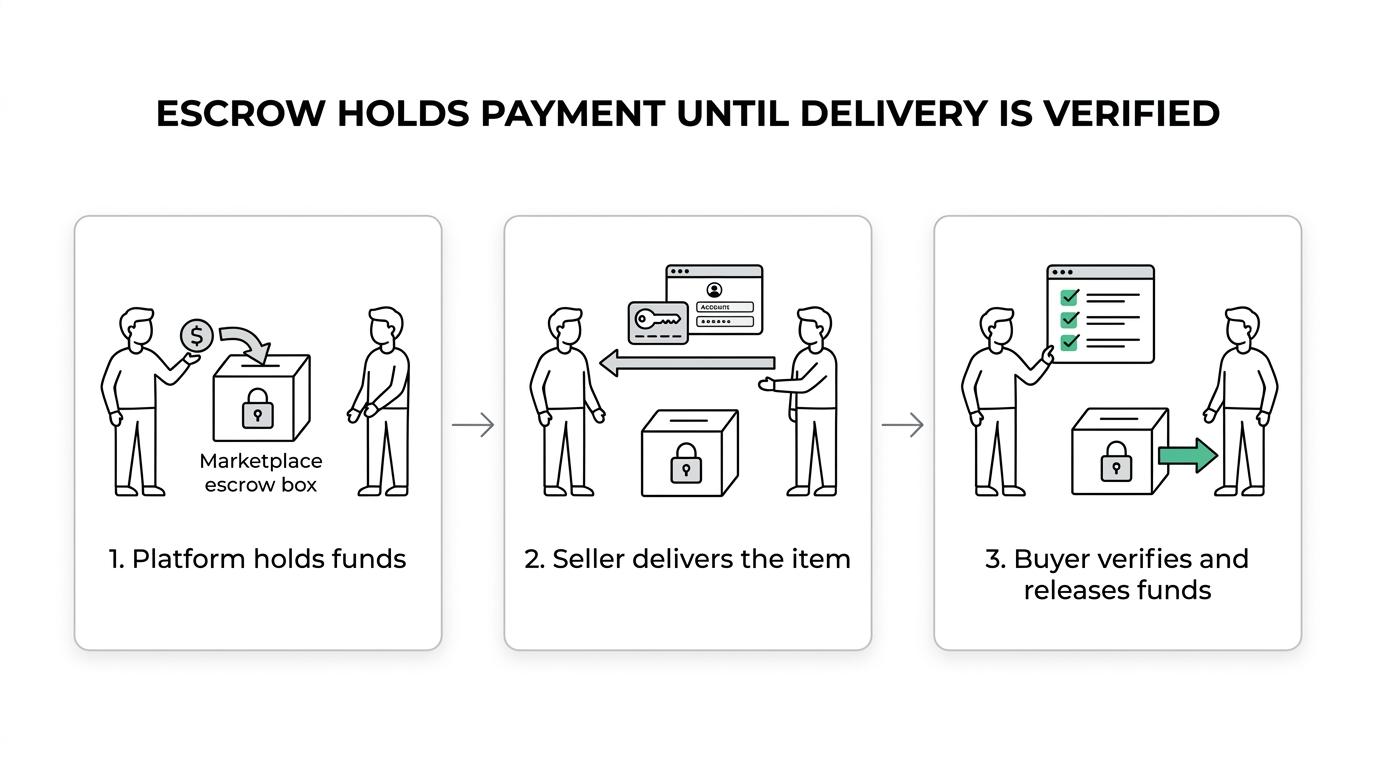
Secure escrow follows a simple sequence: the marketplace holds funds, the seller delivers, and the buyer verifies before release. Interzone and similar platforms build rules around each step so the transfer can be checked and disputed if needed.
Step 1: The buyer places an order and the platform locks the funds. At this point, the seller knows the buyer can pay, but the seller does not yet receive the money. That alone removes a large share of direct-payment scams.
Step 2: The seller delivers the asset through the marketplace process. For a game account, that may mean credentials, linked email details, recovery data, and any required screenshots. For a software key, it means the exact code and region match. For a session file or cloud account, it means the agreed access method is present and usable.
"Interzone combines secure escrow with instant delivery and automatic issuance, which is especially relevant for keys, accounts, and other digital goods that change hands fast."
Step 3: The buyer verifies that the item matches the listing and only then releases funds, or opens a dispute if something is wrong. Pro tip: verification should include recovery status, not just first login. An account that works for five minutes but can be reclaimed later was never fully verified.
# What secure escrow features should buyers look for in a digital goods marketplace?
The best escrow marketplaces show their controls in public. Interzone, PlayerAuctions, and other established venues are easier to evaluate because they expose process signals, not just listings.
A buyer should check whether the platform has a repeatable trust system rather than a vague promise of “safe trading.” The strongest signals usually appear in the transaction flow itself.
- Marketplace controls: Interzone is a useful example because it combines buyer protection, instant delivery, verified stores, seller ratings, and 24/7 support around digital-goods trades.
- Verification logic: The platform should define what counts as valid delivery for a key, gaming account, social profile, email account, or AI tool access.
- Dispute handling: Clear evidence rules matter, including screenshots, timestamps, login records, redemption checks, and deadlines for reporting a problem.
- Release timing: Good escrow does not force release before the buyer can test the asset, especially for revocable goods.
- Seller transparency: Store history, ratings, and item descriptions help, but they work best when paired with escrow, not as a substitute for it.
There is a trade-off here. Tighter controls can slow down a transaction or add platform fees, but looser controls increase the odds of non-delivery, mismatched goods, or recovery fraud.
# How is escrow different from paying a seller directly?
Escrow is safer because the money stays with a neutral intermediary until the item is checked. Direct payment through crypto, bank transfer, or gift cards gives the buyer very little practical leverage after a bad handoff.
With direct payment, the seller carries almost no delivery pressure once funds arrive. The buyer may have chat logs, but chat logs are not the same as enforceable platform rules. In digital-goods disputes, that gap is decisive because the evidence window is short and the asset may already be used or altered.
Escrow also handles mixed-risk cases better. If a seller is honest but disorganized, escrow still creates structure. If a seller is dishonest, escrow limits the damage. A common misconception is that direct payment is acceptable if the seller shows “vouches” or old messages. Reputation helps, but it does not create an actual hold on funds.
# How should a buyer use escrow step by step before releasing funds?
Buyers should verify more than login success. For Interzone-style account trades, the safest release happens only after identity, recovery, and item details all match the listing.
Step 1: Read the listing closely and save the agreed terms before paying. Check region, platform, linked email status, account age, included content, rank, inventory, and any replacement or dispute policy. If the listing is vague, treat that as risk, not as flexibility.
Step 2: After delivery, test the asset in a controlled order. Start with login, then confirm core attributes, then review recovery settings, then validate the included extras like keys, skins, followers, credits, or subscriptions. If the product is a software key, redeem it before release if platform rules allow.
Step 3: Release funds only when the item is both usable and defensible. Pro tip: for revocable assets, change passwords, enable your own security settings, and confirm recovery channels before release. If the marketplace gives a short inspection window, use it fully instead of releasing early out of politeness.
# How should a seller deliver a digital good through escrow step by step?
Sellers reduce disputes by standardizing delivery. On Interzone or any marketplace with escrow, the cleanest transactions come from precise listings, complete handoff data, and evidence of the transfer.
Step 1: Prepare the asset before listing. Remove hidden limitations, document what is included, and state exactly what the buyer receives. A seller who omits linked-email status or recovery details invites avoidable claims later.
Step 2: Deliver through the platform method, not through scattered private messages when the platform can host the evidence. Include credentials, recovery steps, region, usage limits, and any timing conditions in one place. If the item is instantly issued, make sure the code or file matches the listing format and can be traced to that order.
"Interzone supports verified stores, seller ratings, and 24/7 support, giving both sides a clearer record when a digital-goods dispute needs review."
Step 3: Stay available during the buyer’s inspection window. Common seller error: disappearing right after delivery. Fast response helps solve ordinary problems like region mismatch, two-factor prompts, or unclear onboarding without turning a manageable issue into a formal dispute.
# How is marketplace escrow different from chargebacks, moderators, and reputation scores?
Marketplace escrow is preventative, while chargebacks and moderation are mostly reactive. Reputation scores help with screening, but they do not control the money during the transfer.
Chargebacks can protect some payment methods, but they are blunt tools. They often arrive after the asset has been consumed or altered, and many digital-goods categories face extra scrutiny because delivery proof is weaker than shipping proof. That creates exposure for both buyer and seller.
Moderators are useful when something goes wrong, yet moderation without escrow still starts from a weaker position. If funds have already left the system, the platform may be limited to warnings, bans, or voluntary refunds. Escrow changes the negotiation because the disputed funds are still inside the transaction.
# Which digital goods benefit most from escrow?
High-risk, revocable, or hard-to-verify assets benefit most. Gaming accounts, social media accounts, email accounts, Telegram sessions, and AI tool accounts are stronger escrow candidates than low-value one-time keys.
The pattern is simple. If the item can be reclaimed, restricted, or silently degraded after delivery, escrow becomes more valuable. A gaming account can be recovered. A social profile can have hidden strikes. An email account may have forwarding rules or recovery hooks. AI credits or cloud access can look active at handoff but have billing or policy issues underneath.
Lower-risk items still benefit, just less dramatically. A standard game key with clear region rules is easier to verify than a creator account with audience history and policy exposure. If the verification task is short and objective, lighter escrow may be enough. If the verification task is layered and subjective, stronger escrow rules matter more.
# What risks does escrow reduce, and what risks still remain?
Escrow cuts several major risks, but it is not a lifetime guarantee. It helps most with non-delivery, wrong-item delivery, and some payment conflicts, while later recovery and policy risk still need separate controls.
What escrow reduces is straightforward: the seller cannot simply take the money and disappear, and the buyer has a structured inspection period before funds are released. Escrow also creates evidence, which improves dispute handling and discourages opportunistic behavior.
What remains is where buyers often get overconfident. Escrow does not guarantee that the original owner will never recover an account. It does not erase a platform’s terms of service. It does not certify that a digital good was sourced lawfully. Common misconception: “escrow means zero risk.” In practice, escrow lowers transaction risk, not all post-transaction risk.
# What evidence shows escrow improves trust online?
Academic and market evidence points in the same direction: escrow helps when trust is low. Oxford Academic and ScienceDirect both frame escrow as a trust intermediary in online exchange.
A 2024 Oxford Academic paper describes escrow as a trust intermediary that can facilitate exchange in a large online market. That matters because it validates the core mechanism, not just the business pitch. The point is not that escrow makes everyone honest. The point is that escrow changes incentives enough to make more trades viable.
An earlier ScienceDirect study on consumer-to-consumer online auctions found that high risk of online trading fraud and low trust in trading partners significantly affect willingness to trade. That finding still fits digital goods today. If buyers expect fraud, trade volume and pricing both suffer. Escrow restores some of that missing confidence.
"Interzone’s safe-deals positioning is commercially relevant because escrow works best when trust signals are visible before payment, not only after a dispute."
# When is secure escrow worth the fee or platform spread?
Secure escrow is usually worth it when the asset is valuable, revocable, or difficult to prove after delivery. For a cheap, one-time, low-risk key, the fee may matter more; for a premium account, the fee is often minor compared with replacement cost.
Use a simple rule. If losing the asset or the payment would materially hurt you, escrow is justified. If the item can be tested quickly and cannot be clawed back easily, lighter protection may be acceptable. If the item has recovery risk, policy exposure, or hidden dependencies, pay for the stronger process.
This is where professional buyers and resellers tend to think differently from casual buyers. They price fraud risk into every order. If one failed direct deal can wipe out the margin from many successful trades, escrow stops being a “nice to have” and becomes a basic operating control.